
The rise of the Indian middle-class aspirations… what does the data say?
The Indian consumption story is traversing a new chapter. As per news reports, for the first time, SUV sales comprised more than 50% of the total passenger (363,733) vehicle sales in Sep’23. Similarly, for the first time, housing sales in mid-income to premium segment surpassed affordable segment. These trends indicate that the market is shifting towards premiumization as mid-income buyers aspire for higher value premium products across categories – real estate, vehicles, smartphones, hotels and travel. This shows an imbalance as despite high Consumer inflation (6.7% in 2022-23 vs 5.4% 10-year average) impacting discretionary spend, we see a rise in spend on luxury purchases.
A rise in real income leading to rise in proportionate savings driving consumption is a sustainable long-term trend. However, real income of households net inflation, has been on decline in recent years. Interestingly, domestic savings as a % GDP has hit 30.2% (2021-22) diving below 10-year average of 31.3%, and financial savings as a % GDP is at 5.1% (2022-23) below 10-years average of 7.7%. This indicates the increase in consumption and aspiration towards premiumization is coming at cost of savings.
We define financial savings as difference between financial assets and liabilities. The data indicates financial assets grew by 14%, while liabilities by 75.5% (y-o-y in 2022-23). We also see that financial liability to asset ratio has hit 10-year high of 53.5%. Using a liability to build an asset that give long-term positive cash flow is always a prudent measure. However, data shows that proportion of non-mortgage/unsecured loan in household liabilities in rising (doubled in 2023), which implies reliance on high -debt personal or credit card loans to finance consumption expenses such as vacation, tech gadgets etc.
How does this affect an individual?
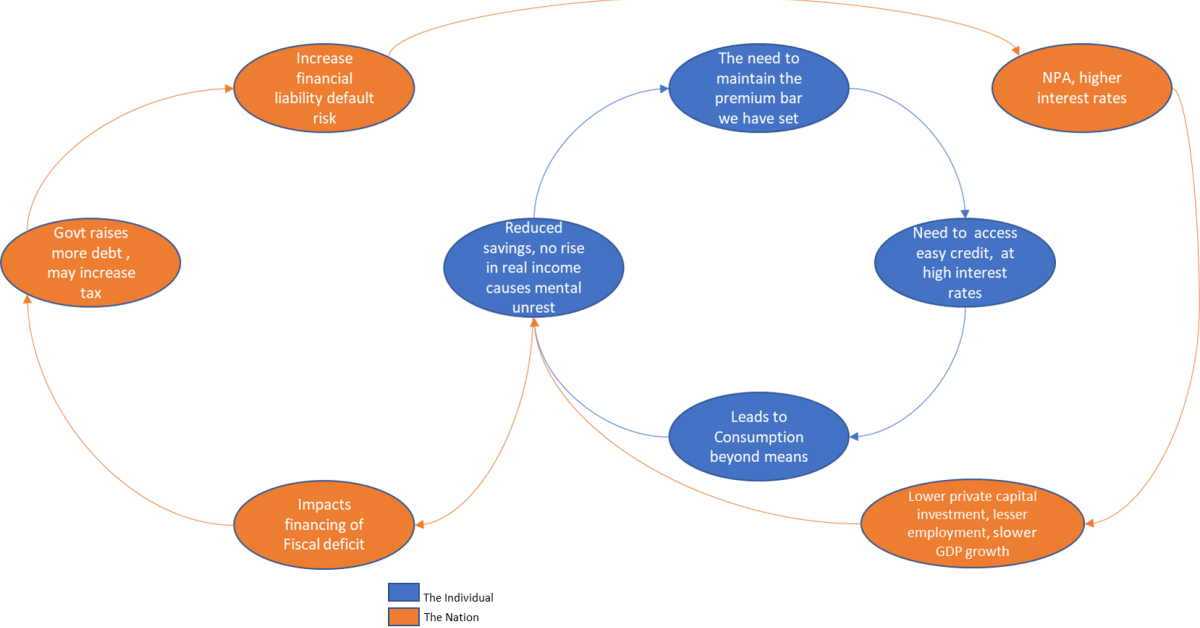
Age old wisdom, often forgotten, states living within means. Today, with easy access to credit / buy and pay later/ one-click EMI facilities, we are easily dragged deep into the world of consumerism sweeping us beyond our ‘traditionally defined means’ and mesmerizing us into the world of glamor and glitz of high-end premium offerings. Once we are into this, its almost impossible to get out. For eg: an I-phone user will rarely go back to Samsung, one driving a SUV will not buy a hatchback next- So it’s a one-way street. This starts a vicious circle: To live upto the bar we have set for ourselves, we start taking easy credit at high rates, and consume beyond means. As savings drip, unless there is proportionate real income gain, we get trapped into a debt circle driven by desire and social obligation to maintain the same bar we have set for ourselves which causes mental unrest in long term.
How does this affect the nation?
In short, while debt-fueled consumption supports GDP in short term, steady rising savings is a key lever for sustained growth. Lower domestic savings impacts a nation’s ability to fund fiscal deficit, which makes a government raise more debt. To fund the interest of the debt, the government may need to raise taxes, which further impacts savings and ability of an individual to reduce financial liabilities, hence default risk. This may lead to rise in non-performing assets in the banking sector, leading to higher interest rates to cover the shortfall, hence triggering the vicious circle at a national level. In the midst, if inflation goes high as is the current case in India, the RBI is forced to increase and maintain higher repo rates to drain out liquidity. High borrowing costs impacts a nation’s ability to fund private investments, which long term negatively impacts employment and GDP, and hence sustainable growth.
Presenting below a schematic on this vicious circle and how it impacts an individual and the nation, christening as 'The circle of Desire to Debt to Downfall'
What should an individual do?
Go back to the Indian root of savings and investments first. The book 'The Psychology of Money' offers time tested solution, and a must read to revise the fundamentals.
written by - Subrata Saharia

Senior Manager, Program Management at Amazon
- Log in to post comments